The man behind the method
Jim Wendler squatted 1,000 pounds, bench pressed 675, and deadlifted 700, totaling 2,375 at 275 pounds bodyweight. He earned those numbers training at Westside Barbell under Louie Simmons, surrounded by the strongest humans on Earth. Then, in the summer of 2005, he walked away from competitive powerlifting.
At 280 pounds, Wendler couldn't tie his shoes without turning red. He couldn't walk down the street without losing his breath. "I was tired of bench shirts, box squats, bands and being fat," he wrote. He'd accomplished every goal he'd set and realized the cost was a body that could squat a car but couldn't function as a human being. What he built next would become the most widely adopted strength program in the world.
First published on T-Nation on July 7, 2009, the 5/3/1 system has since spawned five books from the original 5/3/1: The Simplest and Most Effective Training System to Increase Raw Strength (2009) through 5/3/1 Forever (2017), which contains over 50 training templates. A former English major and University of Arizona football letterman, Wendler's ability to distill complex training into brutally simple principles is what makes 5/3/1 accessible to everyone from high school athletes to lifters over 60.
Why starting light is the smartest thing you'll ever do
The Training Max concept is the philosophical core of 5/3/1. Instead of basing all percentages on your true one-rep max, you use 85–90% of your actual 1RM as your working number. Every percentage, every prescribed set, flows from this deliberately conservative anchor.
Wendler learned this lesson from Simmons himself: "You don't have to train maximally to get strong. You just have to train optimally". The math proves it. Wendler deadlifted 710 using nothing higher than a 650 training max. Training partner Phil Wylie pulled 677 at a meet with a highest training pull of 550×9.
The science backs the philosophy. A 2025 network meta analysis confirmed that autoregulated approaches ranked first for enhancing both squat strength (93.0% SUCRA) and bench press strength (97.1% SUCRA) over rigid percentage based training. The ACSM recommends volume changes of just 2.5 – 5.0% per week to avoid overtraining, 5/3/1's monthly progression falls perfectly within this window.
How the program actually works
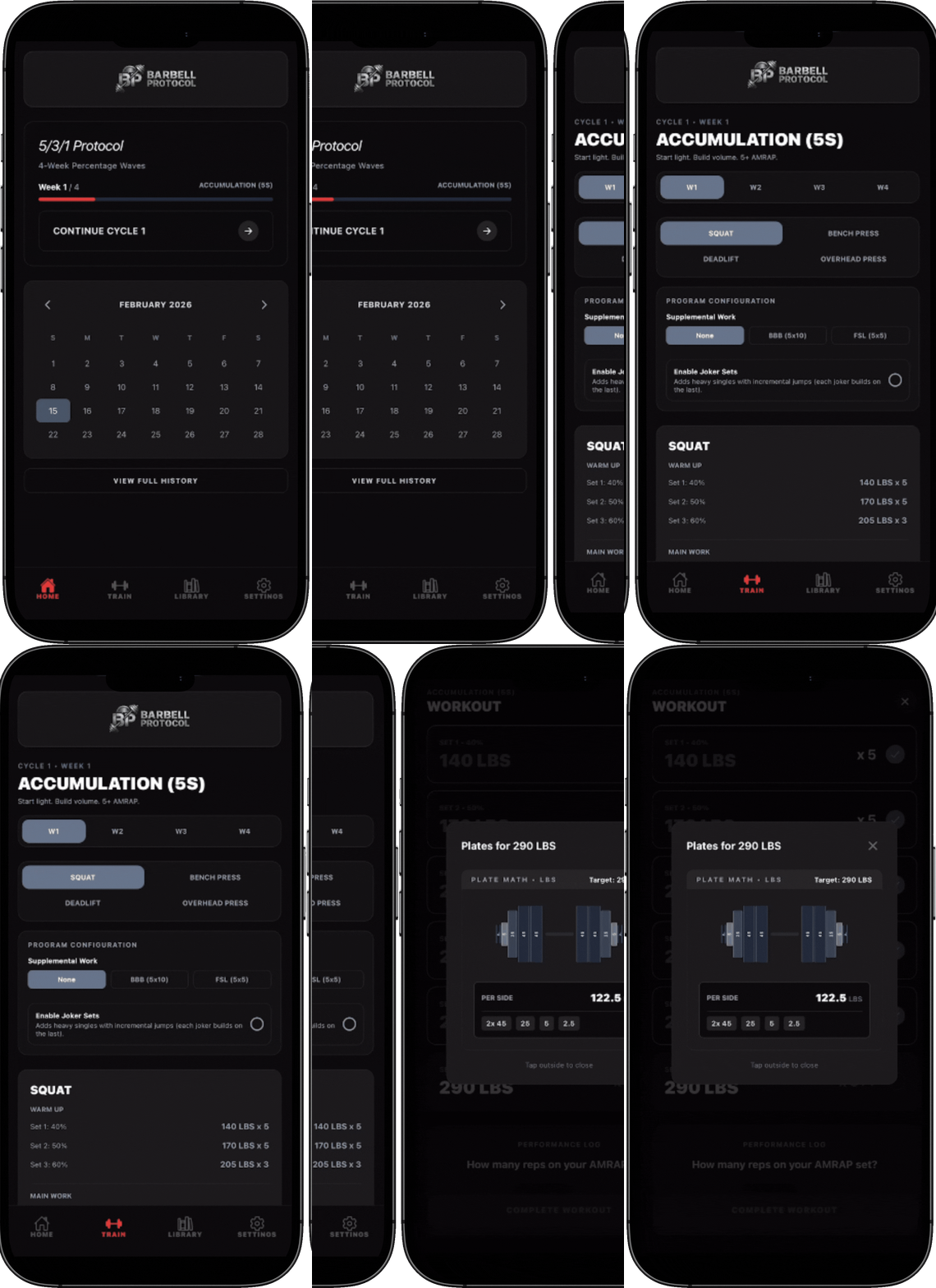
The structure is elegant in its simplicity. Four training days per week, each built around one lift: squat, bench press, deadlift, or overhead press. Each 4-week cycle progresses through three loading weeks plus a deload:
- Week 1 (5s week): Top set at 85% of Training Max for 5+ reps
- Week 2 (3s week): Top set at 90% for 3+ reps
- Week 3 (5/3/1 week): Top set at 95% for 1+ reps
- Week 4: Deload at 40 – 60%
That "+" is where the magic lives. The final set of each workout is performed for as many reps as possible (AMRAP) creating built in autoregulation without RPE charts or velocity trackers. On a great day, you might hit 10 reps on a weight prescribed for 5. On a bad day, you hit the minimum and move on. The system adjusts to you.
After each cycle, add 5 pounds to upper body Training Maxes and 10 pounds to lower body Training Maxes. That's 60 pounds per year on your bench press working weights and 120 pounds on your squat and deadlift. Slow? Only if you measure progress in weeks instead of years.
Variations that keep the system fresh for decades
Boring But Big (BBB) adds 5×10 at 50–60% of Training Max after the main work, Wendler's answer to hypertrophy programming. First Set Last (FSL) returns to the lightest working set for additional volume. Joker Sets allow advanced lifters to push beyond the prescribed top set on strong days, adding 5 – 10% for additional heavy work. 5/3/1 Forever introduced the Leader/Anchor system, Leaders accumulate volume submaxally, Anchors test strength with PR sets creating block periodization within the 5/3/1 framework. Programs like Building the Monolith (featuring 20 rep squat sets and 100 – 200 weekly chin-ups) and Krypteia(high-intensity supersetted training for athletes) demonstrate the system's range.
Who thrives on 5/3/1
The system works best for intermediate to advanced lifters who've exhausted linear progression, but Wendler's 5/3/1 for Beginners variant proves it scales down effectively too. It's particularly suited for lifters over 35, athletes balancing multiple training demands, and anyone who values consistency over flash. One 45 year old father added 40 pounds to his bench in six months. A Reddit user documented moving from a 305 squat to 455 in roughly one year. The program's sustainability runners can run it for years without modification is its defining advantage over faster, more aggressive systems.